Powered By Blogger

Revista Replicante

  • https://revistareplicante.com/
Mostrando entradas con la etiqueta Mexico. Mostrar todas las entradas

domingo, 20 de mayo de 2012

The Death of Carlos Fuentes

In front of Mexico City’s Fine Arts Palace, two black and giant Botero’s fat ladies sculptures flanks the funerary Cadillac limo that would leave his body to the final ashes in a couple of hours —now it’s around four pm—. Mexico City’s may sun is high and burning. The long line of mourners waiting to enter the Palace in order to make a citizen honor guard around the coffin is sweating. Street vendors offer umbrellas, pencil portraits and pirate copies of his book, Aura —the one that everybody read in junior high—. Mostly, people are quiet. Suddenly, a soft wind refreshes the atmosphere, bowling rapidly against Torre Latino Americana, Mexico’s first mid-century skyscraper, counter corner of the Palace. Finally, all who wait would accomplish the rite to pose with grief around his last bed, thinking in a country without its history’s major writer. Trying to figure out why this kind of minds occur once in a while, why the life is so miserly with brilliance.

Carlos Fuentes last ride: in front of Mexico City's Fine Arts Palace

Half an hour before, just taking the subway south of the city to downtown where the public funeral would hold, a fuentesian urban scene: a crippled woman walking with a walking stick,  a regular subway beggar, holding the hand of her little blind daughter, falls from the station mechanical stairs. The little girl cries hopelessly and some citizens help the lady that lies like a wounded she-bear and works hard to reincorporate the still, but apparently she hasn’t major injuries. But the compassion, the feel of a deep pain, comes from the little girl’s cry. She is the pure image of Mexican poverty and alienation. One of the millions of people without hope; inhabitants of the underworld of misery, the ring of abjection that surrounds a monstrous city like this, something that Carlos Fuentes knew for sure and described with literary striking force in several of his novels. Works like his opera prima, Where the air is clear (1958), The Death of Artemio Cruz (1962), The Hydra Head (1978), Christopher Unborn (1987), Constancia (1990), The Crystal frontier (1995) and Destiny and desire (2008), all of them with the textual symbolic and descriptive accuracy of Mexican slums, their lost people and their loss of expectations, a life full of despair.
That is the overwhelming heaviness of the world over an increasing number of people worldwide but especially in the Third World. Something that Fuentes pointed out along his public carrier, consequently with his consistent “modern leftism”, as has called his political point of view through the years UCLA’s Professor Maarten van Delden (you can see his clarifications about it in the next interview in English: http://youtu.be/9NsrbEF2kcM). In the last evolution of Carlos Fuentes progressive thought (that could be placed in the nineties), he affirmed an inclusive view of society, because globalization should be seen as an opportunity to integrate in a planetary scale the old enlightenment values of freedom, happiness and egalitarianism. This quest must be assumed for all the social system shareholders like plutocrats and the State and no just civil society alone. Universal education, democracy, governmental efficiency, pervasive academic and civil critic was some of the principles that Fuentes kept as the keys to make the world a better place to live in given the actual circumstances. His essayistic and journalistic work is full of that, altogether with his famous and brilliant trajectory as a scholar and public lecturer. He always was an old school social liberal.

The author in his eighties

Now his voice is sounding no more. Despite his written words would live for a long time, we will miss his powerful critic description of things in real time. He was the perfect incarnation of Latin (including France and Spain) intellectual, the one worried for public and politic matters and the possibility to express his point of view to wide audiences. Practically until his very last day he was an active participant in the political arena expressing, for example, his distaste for the pretended return to power of the old authoritarian Mexican party, PRI (by its Spanish acronym), and its ignorant and corrupt candidate, Enrique Peña Nieto (you can see Fuentes’ opinions on the matter in the next interview in Spanish: http://youtu.be/ppuA1hYJgVQ).
But that’s the law of life. We were born to die. Destiny reserved for him the fortune to have a long life and a short agony —and deep grief, for sure, like the death of two of his sons in a young age of them—. We will continue reading his marvelous work and we are going to miss for a long time his opinions, the way he opened the world with his privileged intelligence. So long Master, we will try to be up to the level of your invaluable inheritance.


sábado, 28 de abril de 2012

The Bankruptcy of Revolutions


In her remarkable work on the sense, history, symbolism and aesthetics of the twentieth century major ideologies, Dreamworld and Catastrophe, American researcher Susan Buck-Morss, establishes that there is not a lineal road to progress, there is not a central capacity concentrated in an individual or in a small group of them, like the monolithical and authoritarian parties of the last century, capable of pushing humanity toward a pretended new world. There is not a Revolutionary essence that covers a whole nation, period of time or a world class of people that propels necessarily the change of society. On the contrary, there are hybrid possibilities, shadowy lines of action, reactions, hidden purposes, betrayals, and an expansive set of twists and tergiversations of the pretended original objective of a revolutionary action. In sum, Revolution is a myth.
In a post-Cold War analysis of the state of the revolutionary movements around the world, American sociologist Immanuel Wallerstein, points that: «The origins of so-called revolutionary upheavals in the modern world is a difficult and contentious question, and I for one am ready to concede that these upheavals have not represented, for the most part, spontaneous uprisings of oppressed masses seeking to transform the world, but rather, the seizing of opportunity —at least initially— by particular groups».
So, revolutions never were a one way road to certain goal, there was not a progressive dynamic with general participation of people; a straight arrow to the point blank of history. Instead, there has been the space to unleash so well delimited interests of class. The road to power of certain social groups; these groups want the power of state. Typically they are those that have certain social empowerment but desire more. In modern times the paradigmatic case was the bourgeois class, named people with certain education and economic level with the capacity to reunite conceptual and armored forces around a main social purpose, that is, the seize of power. The model was, of course, French revolution, where a very precise social class promoted, directed and got through the battle against the old regime. In the aftermath, they postulated that sovereignty was, from then, in people’s hands. And this has been one of our essential myths in western politics even now. However, actually, sovereignty lies only in that reduced group of people dedicated to manage (through law, politics, economics and so on), according to specific interests, the rights of the rest of society. The case of sovereignty exemplifies perfectly the metaphysical level of revolutions around the world; the operation of an ideological mechanism dedicated to convince, instruct and set up people’s minds in the terms of the power controllers in a certain nation.

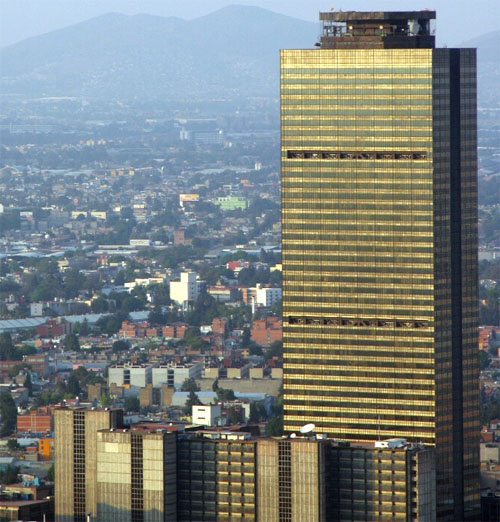
Revolution perverted: PEMEX Corporate skyscraper, built at the beginning of one of the worst Mexico's financial bankruptcies.

Therefore, in general terms, it’s possible to affirm that revolutions are just movements in the top of the social system. For example, let’s take the case of one of the most romanticized revolutions of the past century: Mexican revolution (1910-1920). Certainly there is a history of general uprising all through the country because the unsustainability of the old regime. Society was growing and Díaz’s dictatorship was shrinking. In consequence, when a group of smart bourgeois, leaded by Francisco Madero, decided to challenge the old political power, several other groups began to fight along with them; but the truth was that Madero wanted a process of slow change, proof of that was his determination to keep the old regime’s army.
Renown Mexican revolution historian, American researcher Friedrich Katz has said that one of the key points to the fact that since the end of Díaz’s regime, a century ago, there hasn’t been in Mexico another military dictatorship was that after Madero’s assassination, betrayed by general Victoriano Huerta, his successors in the pursuit of state power dissolved the ancient army and integrated a new one pretended popular. That’s true, but there’s a subtle fact: The main northern leaders of revolution —the ones that won the war— formed armies with several popular representations, former soldiers included, only to achieve their own class purposes. In fact, the revolution’s aftermath brought the constitution of another kind of dictatorship based on those supposed good qualities such as a “popular” army. The instauration of a state party, like PRI, was the beginning of the perversion of revolution.
Yes, defenders of those seventy years of PRI dominance in Mexico’s socio-political life, always remark that during that time, the country passed from an agrarian society to an urban one, that the whole territory was populated with schools, hospitals, roads, ports, airports; peace, an extended bureaucracy and solid political class. Partially this is true. But most of the pretended merits of the post-revolutionary “light” dictatorship of one party were due to the privileged geographic position of the country: an amicable superpower as northern neighbor and a set of weak southern neighbors, and the rest of the frontiers is the full ocean, to east and to the west; altogether, the country has potentially infinite natural resources, leaded by fossil fuels, like oil and natural gas. And there is, too, the hidden history of common people doing their work untiringly every day, assuming their compromise with their family, their country and themselves beyond political ideologies, historical conflagrations or world crisis. That’s the not yet told history of the men and women of street living their lives according with the opportunities of their age.

Revolution lost: Carlos Salinas de Gortari (left) won the Presidency (1988-1994) by a massive fraud, gathered a new oligarchic regime and allowed the enormous expansion of drug trafficking.

Through time, the institutionalized Mexican revolution yielded a social pyramidal order according with the form of the midcentury massive state. Certainly there was an extensive middle class but its formation was due both to the technification of production everywhere and to the accelerated increase of population. To put it in old fashioned Marxist terms, post-revolutionary Mexican middle class wasn’t a social welfare space but an enormous reserve army of people to be exploited for the new class of privileged ones.
Of course, this social structure gave birth to a corrupt, cynic and negligent political class encrypted in the state party, PRI (Spanish acronym for Institutional Revolutionary Party) linked with different actors of power like the new bourgeois class, traditional landlords and transnational capital managers. Within this dynamics, revolution was completely perverted. And if since the beginning it was a revolt from the top in order to change certain aspects of a given status quo, then, at the end it turned into an oppressive and monolithic structure very similar to the one that was overthrown.
Some defenders of the old PRI regime (the same that nowadays want a return to the past in terms of a restoration period to come) have said that it was a legitimate way to rule the people and that the state party structure was formally democratic and akin to free speech and citizen’s basic rights. But that is not true. Beyond several particular examples of authoritarian interventions in civil life —both subtle and violent—, main proof of its totalitarian feature is that real political opposition to the party came in form of dissidence, being the most relevant (among the pacific ones) the one headed by former Michoacán state governor, Cuauhtémoc Cárdenas Solórzano, who lead the country to a cathartic explosion of democracy desire in the endearing 1988 electoral campaign against the state party. As it’s known, those elections were fraudulent and the Revolutionary party stayed in power for another twelve years.

Revolution end game: A man in full, dissident Cuauhtémoc Cárdenas Solórzano (speaking to the crowd) and the dream of democracy at the end of an era.

Then, the truth is that the inception, growth and final decadence of an everlasting authoritarian regime in Mexico was the perfect example of the corruption of revolutions worldwide and the affirmation of their primal feature: there are violent movements to catapult a certain class of people to the nations’ drive. Revolutions probed to be false ways to change the social order from root to top, and instead they only produce new rulers and, in worse cases, new forms of dictatorships. Our times great challenge is to imagine new ways of social integration, sharing of welfare and political participation of the entire citizenship; otherwise, social unrest and new revolutions with their perverse logic could be again in the horizon.

miércoles, 11 de abril de 2012

Democracy afterwards

Pursuing his own purposes, nineteen century Mexican dictator, Porfirio Díaz, declared once that Mexico wasn’t ready for democracy; in consequence, he must rule the country until the right moment for the time of the transition. At the end of his dictatorship amid several social rebellions and general disorder along the country, the old general told to the American journalist James Creelman, in an interview for The Pearson's Magazine, that the country was ready for democracy. Of course, Díaz was just bragging because the country was about to burn in a set of revolutionary explosions north and south, east and west. It was the beginning of Mexican revolution. After that, the country gained everything but democracy. Instead, Mexican citizens obtained the perfect dictatorship (Nobel Prize Mario Vargas Llosa dixit) of the Partido Revolucionario Institucional (Revolutionary Institutional Party) or PRI by his Spanish acronym.  There were seventy years of an authoritarian regime, full of corruption, inefficiency and disdain for the citizens.
A century later, Díaz's asseveration unfortunately has proven to be right: there are not enough conditions to such a system to be fruitful in Mexican soil. Let me make my point. It is not because there aren’t formal institutions like political parties, a federal office in charge of elections, a central management of secret ballot, a national deputy office to survey, investigate and punish irregularities along elections time, and so on. The problem is much more deep and disturbing: there is no majority of citizens to the level of the quest. Because democracy is much more than regular voting, long and expensive campaigns and a mass media blast of spots, news and comments. Mainly, it is a state of mind. It’s a belief-to-action process which central concept is commonwealth. In the age of globalization, citizenship means solidarity with the other unknown. In other words, the capacity to imagine personal situations far beyond our own ones: thinking about extreme poverty, indignity, human exploitation, discrimination; environmental damage, senseless waste of natural resources, urban degradation, and so on. In a word, democracy requires a well informed and sensitive citizenship.
PRI legacy: '68 students massacre.

And Mexico lacks of such a citizenship. Certainly there are some places where people with high labels of education or political consciousness, or both, tries to be aware of the actual state of the nation, promote civil actions to defend their rights and uses different media to influence peacefully other persons in matters like avoiding corruption acts, follow the law and exercise the civil rights everywhere, anytime. One of those places is Mexico City and its urban class. By that, it’s not rare that a liberal party has ruled the town since late nineties, winning three elections in a row by a clear majority of votes. Regarding to this, in a recent poll, Mexican prestigious newspaper, Reforma, found that 55% of the City’s citizens would vote for PRD for Mayoralty and 45% would chose the same Party for Presidency (considerig that there are another three political options). This numbers reveals an inclination for a historically different option in the political life of the country. PRD (Spanish acronym for Democratic Revolution Party), has achieved remarkable political goals in Mexico City laws such as gay marriage legalization, abortion as a legal election for women (restricted to the first twelve weeks of gestation) and an effective separation of governmental affairs from the powerful Mexican Catholic Church intervention.
No matter what, two and a half months before the Federal elections to vote for President, there is a pervasive movement in the country wishing a restoration period with the return of the old authoritarian party that emerged from the Mexican revolution eighty years ago. This party, as the prominent Mexican analyst Roger Bartra has said (his essay on the matter “La hidra Mexicana”, could be seen in Spanish in the next link: http://www.letraslibres.com/revista/convivio/la-hidra-mexicana), haven’t changed its modus operandi. After losing two Federal elections in a row against the rightist PAN (Spanish acronym for National Action Party), the way its politicians are, and its authoritarian and currently corrupted socio-political practices are the same than two or three generations ago. “It is not –says Bartra- that the PRI is turning to the past, it is the past. They cannot return to the past because they never left the past”.

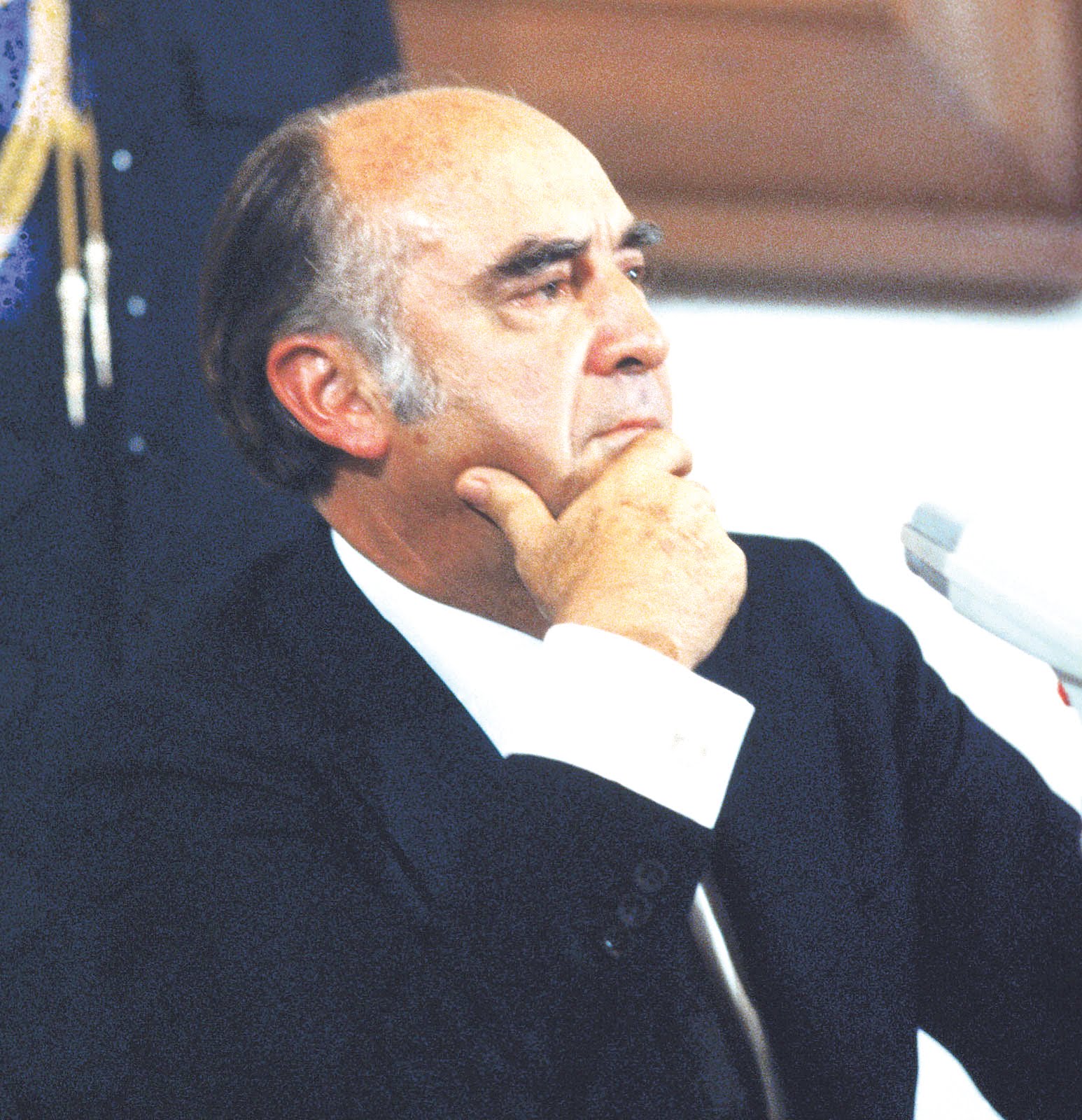
PRI legacy: former President José López Portillo (1976-1982) and one of the worst national bankruptcies.

Bartra’s thesis is that there is a certain orphanage syndrome in a lot of Mexican people and now is exploding in the form of a restoration will. Surely this is true. But there’s another essential factor in the formation of the shocking desire of millions of Mexicans for the return of PRI to drive the nation’s destiny. There is a pervasive ignorance in the majority of Mexican citizens. From humble workers to successful entrepreneurs, entire sectors of society haven’t read a scholar or novelistic book in their entire life. Basically, Mexican people are "educated" through television soap operas, low class funny shows, pro-governmental and biased newscasts and a battery of catholic clichés concerning the form of family, restricted sexuality and traditional genre roles. This TV-directed pseudo education operates like a reinforce of uncritical conservative thinking; that is, the Mexican kitsch that covers most of the national interactions.
Within this framework lies an intellectual blindness that blurs actual reality shapes. Millions of persons in Mexico simple cannot see the real configuration of a political party like PRI. They are blind to the essence of its failure, then and now: that it’s a socio-political formation that is anchored to the past; its way of work, to manipulate people, to spare corruption, to be a one thought organization, to enjoy itself in the national kitsch and a voluminous etcetera, are perceived as good qualities, according to a supposed Mexican reality, exceptional in world history.

PRI legacy: former President Carlos Salinas de Gortari (1988-1994) and 2012 presidential candidate Enrique Peña Nieto: old and new forms of corruption.

But the truth is far different. The kind of formations that the Institutional Revolutionary Party represents are common to the most questioned political parties around the world, named Communist Party of North Korea or Cuban Communist Party. The time of this kind of organizations is over by now. The social system worldwide has mutated into a complex, fast and multi-dimensional entity that cannot be apprehended with monolithical decisions, vertical structures and unipolar thinking. Hence, PRI is an evolutional anomaly. Its form could not fit the present form of the world.
Sadly, the majority of electorate is not to up to level of this reality. In the eternal dispute between conservative and progressive forces, the first ones are winning the battle. It will take an entire generation, maybe two, to invert this situation. Meanwhile, in the short time, there will come a dark period of restoration with the disgraces that come with a major failure in the wrong match between an absurd relic of history and the high requirements of our perplexing world system.

viernes, 2 de marzo de 2012

The new ride of the World Vigilante

In a recent binational meeting in Mexico City, United States’ Secretary of Homeland Security, Janet Napolitano, said that like they did with Osama Bin Laden last year, her country special forces eventually would find Mexico’s ultimate narco, Joaquín “Chapo” Guzmán. “And you know what happened to Osama Bin Laden”, she added. Her asseveration was a real statement about our time's geopolitical trend. With the most prominent army in the world, a worldwide spying net, directed by skilled agencies with long-life experience in the matter, a cutting edge technology both in weaponry and in information gathering and a pervasive set of financial, cultural and political interests in the entire planet, America is a die-hard empire. Since the beginning of the nineties, America has reached its most precious sci-fi dreams in weaponry, as the Army showed worldwide in ‘91 Desert Storm against Saddam Hussein’s Iraq. Nowadays, there is a world of drones, photographer satellites and intelligent rockets operated overseas working day and night on the America’s side.

SEALs in action

In these terms, the operation to bring down Osama Bin Laden was the perfect symbol of the American present times. The entire strategy revealed clearer than ever the new dimension of America’s role in the flat, fast and furious postmodern world: the trend to become a smooth but powerful global vigilante. Not because it had been history’s first time that American special forces make an intervention like that (on the contrary, its known that such practices are common in recent history of US unipolar dominance), but because it settled a crucial turn in their global leadership against the outlaws. We are perceiving a slight but unremitting gliding from straight intervention to surgical extraction or even elimination of the empire enemies. In the near future, major strikes could be done by the use of robotics, and the extensive use of drones in Iraq points in that direction. Meanwhile, key figures of terrorism, organized crime and violent radicals along the world would be retired SEALs’ style. (SEALs, of course, was the unit on charge to erase Bin Laden from the face of Earth.)
In his marvelous report on the hunt and final death of Osama Bin Laden, “Getting Bin Laden”, published in The New Yorker last august, American journalist Nicholas Schmidle, tells in detail the key moments of the military operation to kill public enemy number one. (The text is available at http://www.newyorker.com/reporting/2011/08/08/110808fa_fact_schmidle.) Reading it we get the intelligence to see the kind of efficiency that US Special Forces have in order to survey, find and attack the enemy. There are the prominent results of decades of military leadership in the planet. That is the product of the sum of programs, methods, systems, human training and R&D in war technology to the service of American justice. 

CIA Headquarters

For sure, there’s a number of ethical problems in this kind of justice but for now it’s the best we have in the world. Let’s be clear in this point: United States is an empire and acts like that, period. In consequence, its actions must be seen as the result of its national interests around the world. But at the same time, there’s a righteous sense of pragmatic ethics that the rest of the world (or, at least, the rest of the Western world) can no more than accept with enthusiasm. It’s the realm of the so called community values or national values; that is, the set of presuppositions that we have to assume as essential in order to set up an ethic discourse against alternative ways of thought. American philosopher Richard Rorty worked a lot in this path: in this side of the world, there is no other way to establish right or wrong in national and international affairs than thinking democracy, human rights and free speech as the essentials of our ethical and political practice.
So, this is the actual crossroad of American power: turn itself into a democratic vigilante, no matter how paradoxical this may sound. Maybe that is a good way to move forward its immense fire power and bureaucracy of war. For sure, it would be a right strategy to face its financial decline by cutting the overwhelming expends that traditional wars involve. But at the same time those are good news for the rest of the world: we would have a very efficient crime cleaner on our side.